Archive | Album Review RSS feed for this section

CD Review – Lea DeLaria: Be a Santa

21 Dec

Lea DeLaria: a cat isn’t just for Christmas…

Lea DeLaria: a one-woman melting pot of serious musicianship and showbiz

What makes a great Christmas album? For me, it’s a performer’s ability to bring something new to those familiar songs and carols, with a dash of wit and intelligence – and even mischief. I want something that has a shelf-life which easily overflows the frantic couple of weeks leading up to the day itself, and that I’ll be quite happy to listen to on its merits well into January without the ennui setting in.

So while I’m sure Mariah Carey’s multitude of fans have been thrilled by the melismatic orgy that is Merry Christmas II You, it won’t be agitating my CD player this year or next. And although I’ve been a diehard Annie Lennox fan since her Tourists days – when there weren’t that many of us around – it pains me to say that the earnest intensity of her Christmas Cornucopia had me turning down the volume in irritation, until I was left in silence, watching the snow drift in the darkness through the window.
Be a Santa: one of the best jazz flavoured Christmas albums from a female singer since Cleo Laine's Christmas at the Stables

Then Lea DeLaria’s Be a Santa arrived, and promptly joined that small, select set of Christmas albums on my shelf that I’ll start reaching for every November in search of something to make the winter solstice swing.

Be a Santa is steeped in DeLaria’s trademark vocal dexterity. With her musical partner in crime Janette Mason, she’s taken a host of favourites and whipped them up into a jazzy triumph of verve and invention. She’s all whisky-and-honey tones for a bluesy, brazen take on Loesser’s “What Are You Doing New Year’s Eve?”, tears the house down with a rip-roaring “God Rest Ye Merry Gentlemen” – the band, incidentally, is dazzling throughout – then puts her own thoughtful, close-to-the-mic stamp on “Have Yourself a Merry Little Christmas” that takes you a million miles away from Judy Garland’s trembling vibrato. It’s a rare moment of intimate calm in an album that is otherwise delivered at a fair old lick.

DeLaria doesn’t put a foot wrong as she gets her tongue around some quick-fire lyrics (“The Man With the Bag”) without ever sacrificing clarity. That’s singing of the highest quality. And even when there aren’t words – witness the exuberant scatting on “White Christmas” – you forget you’re listening to songs that should have a strictly seasonal appeal and revel in one of the finest, most fluid voices on the scene. There is novelty, too. DeLaria and Mason have included one of their own compositions – “A Modern Christmas Tale” – which manages to combine a nostalgic, retro melody with allusions to all the angst-inducing banalities of getting ready for the big day in 2010.

When I last interviewed DeLaria, I called her a one-woman melting pot of serious musicianship and showbiz. The integrity of the music is incredibly important to her, she told me, but so is what happens between the songs, and the desire to give a good show on stage is paramount.

“There’s a language to jazz and the numbers, structures and harmonics are all built into it,” she said. “Do I have a talent? It seems to be. If you’d asked me five years ago, I don’t know whether I’d have said that. But having put out three records and worked with the people I’ve worked with, I am ready to say that yes, I do.”

Now, she’s put out four records, and Be a Santa is prime evidence of a vocalist in her prime – and probably the best jazz-flavoured album from a female singer since Cleo Laine’s Christmas at the Stables. The wit is all in the interpretation and if there’s just one thing missing, it’s a risqué, festive “Dirty Martini” moment. If you want to know what I mean, check out Play it Cool, and enjoy. Or just make do with DeLaria’s Egg Nog recipe, included in the liner notes.


CD Review – Signe Tollefsen

1 Dec

Signe Tollefsen sings You, Me & The Brewers. Folk at its noirest

I’ve just been reading Richard Metzger’s fascinating analysis of torch singing on the exciting and eclectic Dangerous Minds blog, in which he gives a generous assessment of the Art of the Torch Singer. Thank you, Richard. Metzger draws particular attention to male artists who have specialised in the genre and his post is well worth a visit. It’s already attracted some interesting comments about singers who should be included in the genre. You’ll find plenty of other connected, music-related material on the site as well. And now, here’s some folk noir for these dark winter days…

Signe Tollefsen's eponymous album. Think dark, then darker still.

You know how the idea of a crisp, snowy December twilight will occasionally work its way into your mind on a steamy summer day, shocking you with a pang of longing to sip whisky in the halo of a flickering log fire while everything hibernates in the shadows beyond?

That’s the effect Signe Tollefsen had on me as I spun her eponymous offering for the first time just a few months ago: perverse, edgy, hankering for the kind of emotional workout that only comes with alcohol-soaked, troubled and troubling relationships. Yikes.

This is folk noir, apparently. And it’s as dark and compelling as anything you’ll find this side of Brel. Tollefsen spins brilliant, diamond-hard images against a gently loping undercurrent of guitar – lots and lots of guitar (some of it of the steel-pedal variety, which in the right hands is always good for conjuring a sense of knives twisting in wounded souls) – banjo, accordion, wailing fiddles and dulcimer. Misery has rarely sounded this inviting.

Dutch-American and an Amsterdam resident, Tollefsen is a born troubadour with a sound as capable of evoking solitary journeys across interminable plains as it is of hypnotic story-telling in the intimacy of a cellar bar.

A cool musicality is revealed in this work (she studied classical singing at the Royal Northern College of Music in her teens) as she plays with rhythms that showcase her bleakly sensual lyrics. “Mama tell me why can’t I sing… Mama let me wallow in my pain,” she sings with uncompromising purity. “I am an art, deprived of a king,” she laments at the receding figure of a dead lover. Vulnerability is exposed. Characters spring to life, doomed unions are played out in a voice of considerable range and, despite the essential gloom of the material, sweetness. ‘The other woman’ is regularly referenced, and themes of duplicity and infidelity creep insidiously into the picture.

And Tollefsen has created a sound that’s very much her own, too. Occasionally, I found myself reminded of Joni Mitchell or the steel-eyed clarity of June Tabor. More prosaically, there is a rather shouty outburst in “History Class” that will certainly appeal to lovers of the full-throated Florence Welch approach to singing. But for the most part, vocally, she keeps her own counsel.

As for the songs, each one is a complete story, told by turns viscerally, through a sequence of potent sensual images, or through a more conventional narrative. I love the opening track, “It Smells of You”, about how the essence of a departed lover hangs around long after the physical presence is gone; the ominous sense of entrapment in “Hooked (You Spit in my Whiskey)”; and the gritty emotional bargaining at the heart of “Up to No Good”. And any lyric that contains the line “I wake up to the smell of gin and regret” (the song has the rather unpromising title, “It Was Ooo”) will always get my undivided attention. Tollefsen sounds like she’s been there. I’ve certainly been there. Haven’t we all? And wouldn’t we all go back for more?

Now those December nights have closed in, the fire is flickering and I’m ready for a bit of heavy catharsis, and Signe Tollefsen is at the top of my playlist. Just thinking about it gives me a chill. Oh go on, then. Pass the bottle, dammit. 

CD Review – Julie Atherton: No Space for Air

16 Nov

Julie Atherton: a rocking live performance of “Blind” from her new album, No Space for Air

A closer look at Julie Atherton’s new album in a second. But first… Producers of the mooted 2011 London Follies revival apparently don’t think Bernadette Peters is sufficiently “box office” to carry a production on this side of the Atlantic. So murmurs the rumour mill. Ye gods. Here is one of the great leading ladies of our time – sure, a superstar on Broadway, but also a performer whose status and reputation is global as far as anybody who knows anything about musical theatre is concerned. And she is a luminary among actors who have specialised in Sondheim. You can’t buy the kind of gold dust she would sprinkle across the West End.

Never mind. Let’s wait 10 years. Then Dannii Minogue can give us her Sally, Cheryl Cole can step up to the plate as Phyllis, Susan Boyle’s “Broadway Baby” can raise the roof and Amanda Holden can summon her acting skills to deliver “I’m Still Here” with all the dramatic irony she can muster. And we’ll have the television audience-friendly Follies we apparently deserve. I can hardly wait. So I’ll probably curb my impatience with a trip to Washington DC in the spring, where Peters is scheduled to be a fascinating Sally, and Elaine Page will appear as Carlotta Campion, US producers apparently still being able to think outside the box just a little.

No Space for Air: a fascinating collection of modern pop and theatre songs

Julie Atherton will be a prime candidate to play Sally if there’s a revival to mark Sondheim’s centenary in 2030 – although she’d better make sure she’s got a television profile by then or she’ll have a tough job convincing the impresarios of the future.

Atherton is one of a handful of young West End leading ladies who composers would have been queuing up to write parts for in the old days. She’s a veteran of the cult hit Avenue Q and in the age of juke box musical dominance, through her involvement with the Notes From New York project, she consistently does her bit to promote new musical work in London.

When I saw her in their production of Jason Robert Brown’s chamber piece The Last Five Years last summer, it was clear that she was the genuine article: an actor with the instinctive ability to interpret lyrics in character so that they become part of the dialogue. Even so, I approached her new album, No Space For Air, with some trepidation. Musical actors ‘doing’ pop can be wince-inducing; I refer you to some of John Barrowman’s big finale numbers on the BBC’s Tonight’s the Night.

But Julie Atherton rocks. This modern, thoughtful collection of songs – produced with obvious attention to detail – is provactive and inspiring by turns. There are a couple of theatrical numbers: the tricky tale of “Lost in Translations” from Craig Adams’s Lift; and the most radical reworking of Sondheim’s Follies torch song “Losing My Mind” since Liza Minnelli’s 1989 electric disco collaboration with the Pet Shop Boys. But the bulk of the material is from the pens of edgy, contemporary songwriters like Mark Tremonti (“Broken Wings”) and Jake Hook (“Silent Whispers”).

Atherton is well served by arranger and pianist Craig Adams, with a string quartet adding some evocative accents to the pristine sound of the band. She launches into the opening track, “Weak”, with a cross between Emmylou Harris’s crystalline soprano and the finer emotive qualities of Celine Dion, sweet, country-flavoured tones shot through with moments of controlled power. The effect is exhilarating.

“Crawling” matches anything else on offer from the current clutch of young female artists. Atherton’s ability to inhabit a song and tell its story with emotional conviction but none of the artifice that so many singers rely on – let’s call it the curse of X Factor – is refreshing. She switches in a breath from subtle and gentle (“Never Saw Blue Like That”) to quirky and vulnerable (Tori Amos’s “Leather”).

The title of “Encore”, technically the last track on the album, raises the prospect of theatrical resonance but turns all such expectations on their head with a soaring exhortation to live in the present. But leave the disk on the player for a hidden treat: Atherton’s poignant take on the John Denver classic “Annie’s Song”.

CD Review: Home – Rosie Nimmo

13 Nov

Timeclock: Rosie Nimmo’s unsettling exploration of life’s rapid pace

Home: the follow-up to Rosie Nimmo's first album, Lazy and Mellow

Mid-November, with a gale flinging the leaves against the window and a darkening sky that seems to promise eternal winter: it’s the perfect time to be listening to Home, a second album from Edinburgh singer Rosie Nimmo.

Not because Nimmo’s lyrics are relentlessly bleak and introspective – although they have their moments – but because despite a sheen of melancholy, little beacons of hope, comfort and warm humanity flicker across her complex vision of life’s travails. Just when you think the darkness is closing in for good, there’s a nip of something strong and reviving to pick you up and give you a wry laugh.

“The secret’s to enjoy the view

If you can enjoy the people too,”

Nimmo sings with cool irony in the opening track, “Never go Back”. And there’s the rub, of course, because it’s people who tend to get in the way. Nature can be a more rewarding companion. Songs like “Moonglow Music” and the title track are like little oases in a landscape of experience that in other numbers – the desolate “Life Can Pin You to the Wall” and “Low Blue Way” with its aching harmonica (a Nimmo speciality) – is often obscured by mist.

Rosie Nimmo in concert at Queen's Hall, Edinburgh (Picture by Marc Marnie)

“The End” is a frank and simple account of leaving things too late in a relationship. Perhaps, as Nimmo suggests in “Listen to Your Own Voice”, it’s ultimately best to be accountable to your own instincts. That way lies inner strength.

This is a wise collection of songs that faces up to some rough realities, not least in the unsettling, driven “Timeclock”, a sensory exploration of life’s rapid passage that really works its way under your skin. But there are moments of joy in the infantile escapism of “Being a Child Again (in the Snow)”, and even the sad tale of “Little Bird” ends on a note of fragile hope.

Nimmo’s style veers between soft, gentle folk and an edgier, almost bluesy quality that keeps you guessing where the mood will lead her. There is some exemplary, unfussy accompaniment from, among others, producer Marc (Hobotalk) Pilley on guitar, keyboard player Ali Petrie (the much-neglected Hammon organ comes into its own on several tracks) and fiddler Mairi Campbell.

Subtle, understated and sure-footed, Home is an intelligent, rewarding piece of work full of quirky hooks and rhymes that send your thoughts spinning off in all kinds of unexpected directions.

CD Review: Joyce Cobb with the Michael Jefry Stevens Trio

5 Oct

The making of the album: Joyce Cobb and Michael Jefry Stevens in the studio

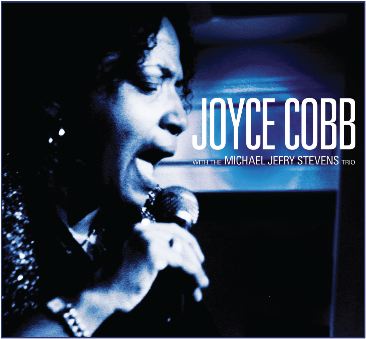
Joyce Cobb with the Michael Jefry Stevens Trio: an album of considerable quality

I’d never claim to be a jazz expert, so when I listen to a singer who’s been filed in that particular section, it’s as the eternal novice. As with the work of a painter or a sculptor, my response is always visceral. I like it instantly or I don’t. Very occasionally, something grows on me after several plays or over the course of a set at a gig. But usually, it’s that first reaction that sticks. I’ll leave the hardcore analysis to the genre’s aficionados.

So what was my first reaction to Joyce Cobb with the Michael Jefry Stevens Trio? Aside from the fact that it doesn’t exactly trip off the tongue as an album title, I was hooked. “Right, here we go,” says Joyce Cobb , one of Memphis’s finest exports, at the start, launching into a harmonica intro to “Moanin’” before unleashing her warm, honeyed tones on the lyrics. It’s a potent combination that leaves you in doubt that you’re in the presence of an assured, class act.

Cobb might be billed as a jazz singer, but there is plenty of soul in her voice too. That means comparisons with Ella (coming through in Fats Waller’s “Jitterbug Waltz”), Billie (whose ghost is surely hovering in “If You Know Love”) and Sarah are inevitable. She certainly doesn’t come up short in the bold phrasing or the way she takes the melody and unravels it like a fine thread of gold. She bends it and stretches it but never lets go of the line. That’s a singer’s singer for you. And in the company of Michael Jefry Stevens on the piano, with Jonathan Wires on the bass and Renardo Ward on drums, she has precisely the framework she needs to work some intriguing magic with this set of standards. And comparisons aside, what comes across most clearly is the art of Cobb herself, in absolute command of every song, serene and completely comfortable within the music. Her voice is a prism of shifting moods and emotions.

There’s a beautifully restrained “Skylark”, with Stevens sublime on the piano, a playful “My Heart Belongs to Daddy” that banishes the threat of Earth Kitt-style outrageousness to the far reaches, and a lovely mash-up of the Dorothy Fields/Jimmy McHugh ballad “I’m in the Mood for Love” with some new lyrics from James Moody. “If You Never Come to Me” has a breezy samba quality. Stevens lays on the atmosphere again at the start of the plaintive Jimmy van Heusen/Johnny Mercer number, “I Thought About You”. It’s Wires’ turn to shine with a spare accompaniment to Duke Ellington’s lament “Daydream”. By the time Cobb gets scatting – something, I’ll admit, I’ve always found an acquired taste – on Thelonious Monk’s “It’s Over Now (Well You Needn’t)”, she’s long since had us in the palm of her hand.

This is an album of considerable quality that rewards repeated listening, which is just as well for us here in the UK. In the absence of any London gigs from Cobb, we’ll have to make do with it for the time being.

Lucky readers in mainland Europe, however, can find her with the Michael Jefry Stevens Trio on tour right now in the following cities: 5th October, Prague (Jazz Dock); 6th October, Graz, Austria (Stockwerk); 7th October, Vienna (Reigen-live); 8th October, Darmstadt, Germany (Knabenschule); 9th October, Luxemburg (L’Inoui Café); 10th October, Brussels (L’Archiduc); 11th October, Frankfurt (Jazz Keller); 12th October, Reutlingen (Artgallery Reutlingen); 13th October, Neustadt (Katakombe); 14th October, Paderborn (Jazz Club), 15th October, Lausanne (Chorus); 16th October, Chur, Switzerland (Jazz Club).

EP Review: Someday – Maini Sorri

30 Sep

Maini Sorri’s biographical video for her participation in I’m a Hollywood Star features clips from several songs featured on Someday

Someday: deceptively simple lyrics combine with melancholic undertones to generate an ABBA-esque frisson

Not everyone can take a quirky little ditty and make it credible. It takes sincerity, a deal of musical sensibility and a belief in the ultimate message of a song that is probably greater than the sum of its parts. Maini Sorri seems to have the ability in spades. How about this for a couplet?

“Truth is you were selfish and a phoney.

I shouldn’t have trusted you and your baloney.”

It’s one of my favourite snippets from her new EP Someday, a small collection of five songs that frequently reveal a melancholy undercurrent beneath their whimsical lyrics and well-crafted melodies. Does that sound reminiscent of a certain other Scandinavian outfit? I’m not suggesting that there are huge similarities between Sorri’s work and the nuances of Benny and Bjorn’s finest numbers. But in the deceptive simplicity of lyrics that can sound banal, even childlike, at the first hearing before they work their way under your skin, and the layered arrangements, guitar-driven and piano-based, with their minor accents, it’s impossible not to detect a hint of ABBA’s mastery of the accessible pop tune with the dark back story.  And it’s no surprise that she cites Agnetha Faltskog as one of her main singing influences.

Sorri is a Finn who lives mainly in Sweden and is gifted with a pure, crystalline voice that easily covers the ground between pop and the more mainstream reaches of modern folk. Her accent – more shades of that ABBA-like appeal – gives these songs an air of innocence, a lack of guile, that surely belies her all-round musical strengths. She knows exactly what she’s doing and the sound she wants to achieve, and the result is a modest little box of jewels, from the catchy, twinkling intro of the title track (don’t be fooled, it soon gets elemental and philosophical, and has its eye on the great hereafter) to the gently contemptuous “I Shouldn’t Have Trusted You” (source of the baloney reference) and the sadly defiant “I Am Leaving”, which is also offered in Finnish as “Lahden Yksin”.

My first thought on playing “Someday” was that it has a certain Eurovision quality – in a good way. I don’t know if Sorri has tried her luck yet in the Finnish or Swedish selection processes for the contest, but reading her thoughtful and intelligent blog posts on the subject, I wouldn’t be surprised if she has ambitions in that direction. With a growing following – not just in Europe but also in the US and Canada – this could be a prime time for her to make that particular move.

CD Review: Dolores Scozzesi – A Special Taste

17 Sep

The blues are just torch-songs: Dolores Scozzesi in performance

Dolores Scozzesi: there's nothing like discovering a new voice

There is one good thing about returning from holiday: a healthy pile of CDs for review has accumulated during the summer, promising plenty of interest to lighten the darkening autumn evenings. An even better thing is when you pick one, randomly, from the pile, put it on and out of nowhere, a new voice stops you in your tracks.

After all these years of listening, and not to sound too blasé about it, the “Wow” factor needs to be pretty strong to have that kind of effect. And it really has to be something different. So thank you, Dolores Scozzesi, for working a little magic as the last dregs of summer evaporate.

A Special Taste appears to be New York-born Scozzesi’s first album – and it’s long overdue, given her credentials: Lee Strasberg Institute alumna, one-time voice student of Phil Moore, improv specialist who has performed alongside Robin Williams and Jay Leno, former ex-pat resident of Lyon who has toured Europe with her own jazz troupe, and singular cabaret performer who has ripped up Sondheim and Sting to great acclaim on the West Coast.

It’s the voice that grabs you to begin with. A rich contralto with edge, snapping from molten serenity to a predatory growl in a single phrase, and a timbre that makes you want to place your hands on the speakers just so you can capture something of its individuality. She switches easily between the ominous (“Stay Out of the Moonlight” is a glorious don’t-do-as-I-did word to the wise) and the edgy. “Jazz is a Special Taste” is a stop/start exploration of the allure of the genre to which Scozzesi has loosely hitched her star.

I say ‘loosely’ only because throughout the album, she seems to be daring the listener to put her in a specific box. The phrasing sounds so spontaneous that I doubt any two live performances of a song are ever exactly the same, in the great tradition of artists like Billie Holiday and Sarah Vaughan. And as with those greats, the story telling is commanding. You have no choice but to listen. The arrangements by Eli Brueggemann and Gary Fukishima give her the ideal springboard to create these vivid word pictures.

Then there is the choice of songs. Standards from Cy Coleman and Carolyn Leigh (it’s a long time since I heard anyone treat “You Fascinate Me So” with such dry wit) and Fred Ahler and Joe Young (“I’m Going to Sit Right Down and Write Myself a Letter”) have strange but fascinating bedfellows in a pair of Bob Dylan numbers, an astringent take on “One More Cup of Coffee” and a moving, bossa nova treatment of “Just Like a Woman”.

I don’t know what the Dylan purists will have to say about that, but as a late comer to the Dylan lyrics appreciation society myself (I’m no lover of his voice, and that’s been something of a barrier to enjoying his work), I’m fascinated by the endless reinvention that he attracts these day, particularly from female vocalists. Long may it continue.

Scozzesi’s liner notes shed significant light on the final number on the disk, an acoustic treatment of “Autumn Leaves”, melding Johnny Mercer’s English lyrics with the original French words of Jacques Prevert and culminating in a self-penned vocalese tribute to her late husband, dark, raw and touching. This is an album to be enjoyed in discerning company, with firelight and good wine.

CD Review: Ellen Woloshin – Water Into Wine

17 Sep

Ellen Woloshin sings “Joanna”, a song from new album Water Into Wine

"Water Into Wine": sophisticated, literate and absorbing

“Where does all the time go?” asks Ellen Woloshin on the fifth track of her new album, Water into Wine. It’s a good question, coming half way through a collection of largely self-penned songs that have already taken us through several shades of loss and the cyclical nature of relationships.

By this stage, what starts out like a break-up record, with a touch of Carole King-style self-affirmation (“Making My Way Back (To Free)”), has marked itself out as a sophisticated piece of work, defined by literate lyrics, absorbing key changes and modulations, and underpinned by a shifting, restless quality as the core of each song crystalises before Woloshin moves on to another point of view.

She has a lot to say about life experience and – the sign of an assured and skilful songwriter – she says it with clarity and economy.  Music Connection Magazine described her approach as “decidedly female-friendly”, an epithet that strikes me as unnecessarily limiting for such universal lyrics; sure, one or two numbers – “Just Come Home” and “The Words” – might be tagged ‘women’s songs’ but nobody should be put off by such rigorous demarcation.

New Yorker Woloshin is the daughter of celebrated jingle writer Sid, and made her own early way spinning jingles for some well-known American brands. For some time, she’s written successfully for other people, including Dionne Warwick, Ben Vereen and LaToya Jackson. It’s an impressive career path that must have been invaluable in honing her gift for blending instant accessibility with personal reference. Woloshin’s pure alto voice has emerged as a fine, elegant vehicle in its own right, adept at expressing sentiment without pitching into sentimentality.

“Joanna” is a song about the ache of loss; “Round We Go Again” captures the relief of a relationship recovered from the brink; “Don’t Talk to Me That Way” captures the stealthy, destructive blight with which a cruel word can infect a love affair; “Let It Go Now” is a pick-yourself-up message of hope.

There are two odd songs out: Lennon and McCartney’s “We Can Work It Out”, punctuating the line of experience described by Woloshin and her songwriting partner Jennifer Dent with a loose, almost jaunty interpretation of the Beatles classic; and Barney Griffin’s “You Break My Fall”, which brings the set to a calm, poignant resolution. Astutely produced by Steely Dan veteran Kevin Bents, Water Into Wine is a smart, polished advertisement for an impressive talent.

CD Review – Monica Mancini: I’ve Loved These Days

25 Jul

Monica Mancini proves her musical pedigree at the Montreux Jazz Festival

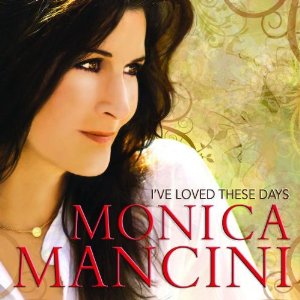
I've Loved These Days: a cherry-picked playlist of rare quality

It isn’t often that I’m tempted to call an album “flawless”. There is usually a track or two that misses the mark, doesn’t connect with the whole, has a slight hint of beating the deadline about it – good enough but not quite in the zone. But Monica Mancini’s I’ve Loved These Days has such a calm sense of completeness about it that I’ve found myself staring at the Bose in astonishment. During the first listen, round about an absorbing reinvention of “How Can I Be Sure” – a number I’ve only ever associated with Dusty Springfield, despite David Cassidy’s best efforts – I actually caught myself thinking, “They really don’t make records like this any more.”

And to be honest, in the best possible way, there is a strong retro feel about the whole thing, not least because Mancini’s phrasing and diction are so effortlessly cool. You don’t miss a single lyric – and how often does that happen these days? Every word is considered, explored and offered up with an honesty that brings to mind female pop singers of the highest calibre: Karen Carpenter or Dionne Warwick at their instinctive best.

The choice of songs also adds to the sense of a time slip. Mancini has cherry-picked a 1960s playlist of rare quality – and in many cases enlisted the help of their originators: Jackson Browne plays guitar and sings backing vocals on “These Days”; Stevie Wonder’s unmistakable harmonica burnishes “Blame it on the Sun”; and Brian Wilson – vocally ageless – features on an intriguingly pared-down “God Only Knows”, giving Mancini the chance to show her mettle against a taste of those legendary Beach Boy harmonies.

These collaborations are testament to Mancini’s musical pedigree, as the daughter of Henry Mancini, the composer behind some of the most iconic film soundtracks of the 20th century. Many of the songwriters she honours here were her father’s peers and clearly exerted a profound influence on her own musical development. Indeed, she calls them her “musical heroes” and offers I’ve Loved These Days as a discovery of what their songs continue to reveal. In that sense, the album makes an interesting comparison with Barb Jungr’s The Men I Love. They both raise a musical toast to Paul Simon, for example: Jungr with “My Little Town” and Mancini with “American Tune”.

Although this album isn’t exclusively American in content – there is a poignant take on the Lennon/McCartney number “I’ll Follow the Sun” – an undercurrent of oblique commentary on the modern emotional landscape of her homeland occasionally ripples to the surface, particularly in the compassion of the Fran Landesman classic “Ballad of the Sad Young Men”, Billy Joel’s “I’ve Loved These Days”, and the flute-dusted beauty of Janice Ian’s “Joy”.

The arrangements are spare, acoustic and almost regal in their simplicity. Mancini clearly didn’t want to simply do an all-purpose album of cover versions. Instead, these are gleaming reinterpretations in which the lyrics take centre stage. Producer Phil Ramone – who had a hand in the original versions of many of these songs – has brought all his skill to the mixing desk, giving Mancini’s fluent, elegant vocal line all the air and space it needs to soar above the tasteful, sympathetic arrangements of Jorge Calandrelli. “I’ve Loved These Days” is a breath of fresh air in a musical climate that is so often hell-bent on over embellishment and extravagance. Perfect.

CD Review: Emilie Simon, The Big Machine

11 Jul

Rainbow: a track from Emilie Simon’s new album, The Big Machine

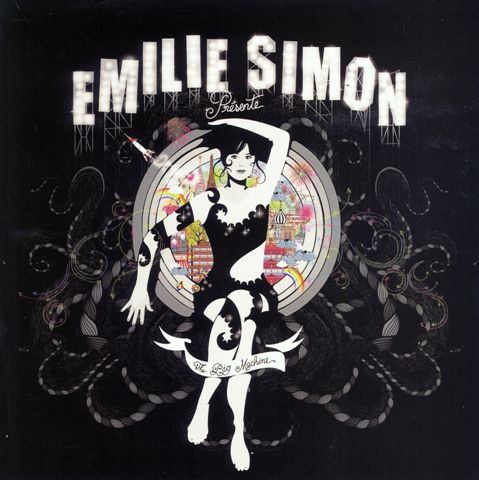
The Big Machine: a new musical vision of an iconic city

A few weeks ago I berated PRs who use the “New Kate Bush” tag to try and snatch a bit of space for the latest quirky singer in a niche that, despite the heralding of numerous would-bes, has only ever really been occupied by one talent. Here, for one night only, I’ll eat my words.

Emilie Simon, a French electro-pop singer and composer (or “sonic auteur” according to the slightly pretentious blurb) with a strong track record in her home country, is already a cult figure in her adopted hometown of New York. Her new album, The Big Machine, a conceptual tribute to the city, is about to hit the UK on a tide of gathering interest. And it doesn’t take more than a couple of spins for the aptness of the Bush comparison to make itself abundantly clear.

At times, the extraordinary swoops and intervals of Simon’s vocals are so reminiscent of Bush’s early work, the timbre so similar, that for a second, it’s like being transported back 30 years to a time when the idiosyncratic masterpieces of the UK’s most singular female singer-songwriter carved such a significant path through contemporary pop. But the comparison works – and is a tribute to both women – because once the frisson has passed, it’s quite clear that Simon is a formidable and unique talent in her own right.

Not for her the metaphysical expeditions across the inner landscape of Bush’s child-woman, with their obscure literary and philosophical references. Simon’s lyrics are emphatically 21st-centry urban, rooted in accomplished, synthesised beats.

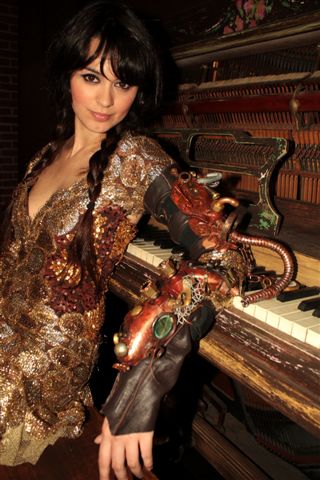
She’s a one-woman electro-band, a pioneer of “The Arm” – a rather startling, customised sleeve that gives her complete control over her musical gadgets and voice manipulation technology and which, in live performance, allows her to replicate the complex, symphonic qualities of her recordings.

Brick by brick this Brooklyn resident constructs a musical picture of an iconic city that obviously has her firmly in its grasp. Simon’s is a different kind of skyline, far removed from the art deco canyons or concrete jungle conjured by the likes of Gershwin and Bernstein.

Emilie Simon: one-woman electro-band

The album is full of arresting juxtapositions: the near cacophony of the urgent brassy intro to “Rainbow” setting up the first appearance of Simon’s deceptively girlish voice; the retro electronica – almost Thompson Twin-like – of the hypnotic “Dreamland”; the brilliant, glittering vocals of “Nothing to do With You” (the most Bush-like of all the tracks, and for me, the album’s standout number, along with “Closer”); the brooding promise of adventure in “Chinatown”.

Moods shift in the flicker of a neon light as Simon subtlely works the technology to give her voice a new resonance. It’s great to hear a genuinely different sound cutting through the increasingly homogenised legions of young female singer songwriters.